50 humidifiers · 17 brands · 35 that cannot make white dust · ~$40–$1,100 · updated September 2026
The square footage on the box is not a measured number
Nobody certifies a humidifier’s room-size claim — AHAM runs directories for air cleaners and dehumidifiers, and none for these. So this site recomputes it. Every unit here carries the room its output really supports, how long a tank lasts if it were holding the room on its carton, and what a year of wicks and watts costs.
- Overstate their room
- 26 of 45by more than 15%
- Typical overstatement
- 1.2×median across the catalog
- Furthest off
- 5.4×HoMedics TotalComfort Deluxe Warm & Cool
- Closest to honest
- 0.51×Vicks Warm Mist Humidifier V745A
Biggest output here is the Aprilaire 800 Steam at 35 gal/day, enough for 8,524 sq ft. Cheapest to run is the Levoit Classic 160 at ~$5 a year.
Every humidifier we track
Filter by the room the output actually supports rather than the number on the carton. Tick up to three and their spec sheets line up in one table.
50 humidifiers found
Aprilaire
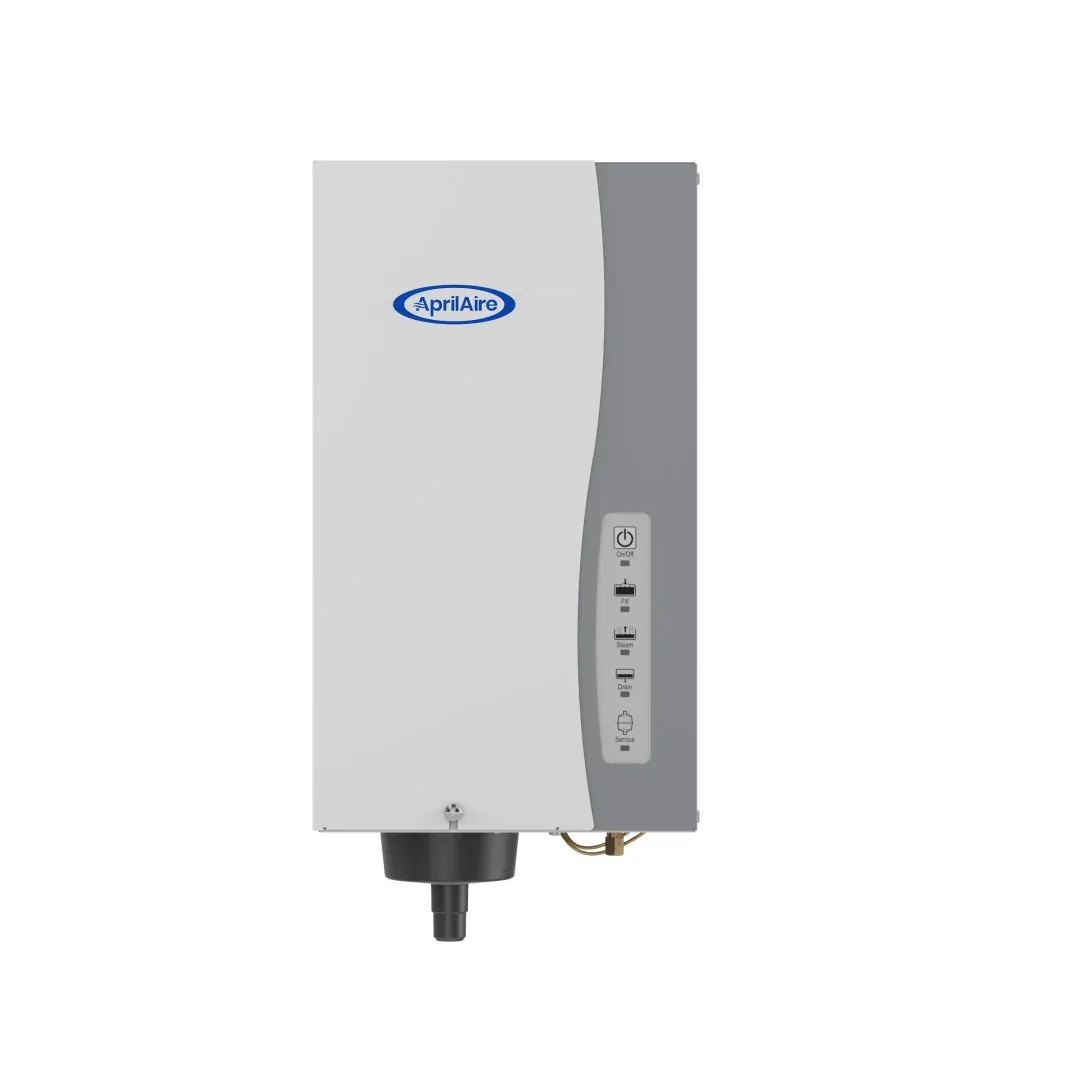
Aprilaire 800 Steam
Nearly 35 gallons a day, which is twice the biggest evaporative here and three times any portable. A steam humidifier boils water with electrodes and injects the steam into the ductwork, so unlike every evaporative unit it does not care whether the supply air is warm - it makes its own heat. That is what lets it serve a 10,000 sq ft house, and it is also why it needs a dedicated 240V circuit and why installation runs $1,800 to $4,200. There is no water panel to buy, which is the one running cost it removes; the 11.5 kW it draws while steaming is the one it adds.
8,524 sq ft supported · box says 10,300 sq ft
Aprilaire
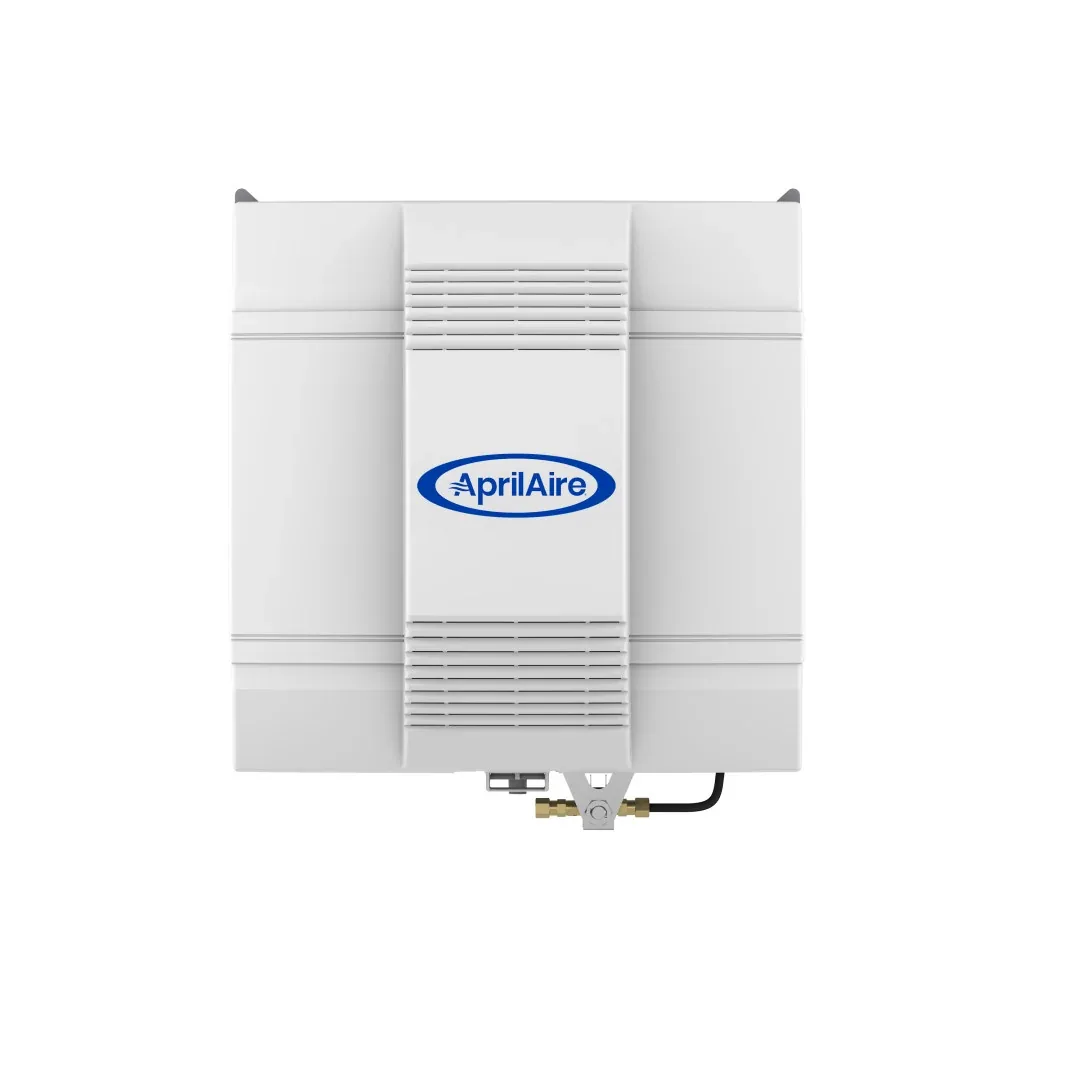
Aprilaire 700 Fan-Powered
The fix for the bypass units' one real flaw. A fan-powered humidifier has its own blower, so it can run independently of the furnace - on a mild day when the heat barely cycles, this one still humidifies and a 500 or 600 does not. It also needs no bypass duct, which makes it the easier install where the furnace is tight against a wall. Eighteen gallons a day, 5,300 sq ft claimed for a tight home, and around 3,000 for an average one by Aprilaire's own guidance. The load calculation lands at about 4,400.
4,434 sq ft supported · box says 5,300 sq ft
Honeywell
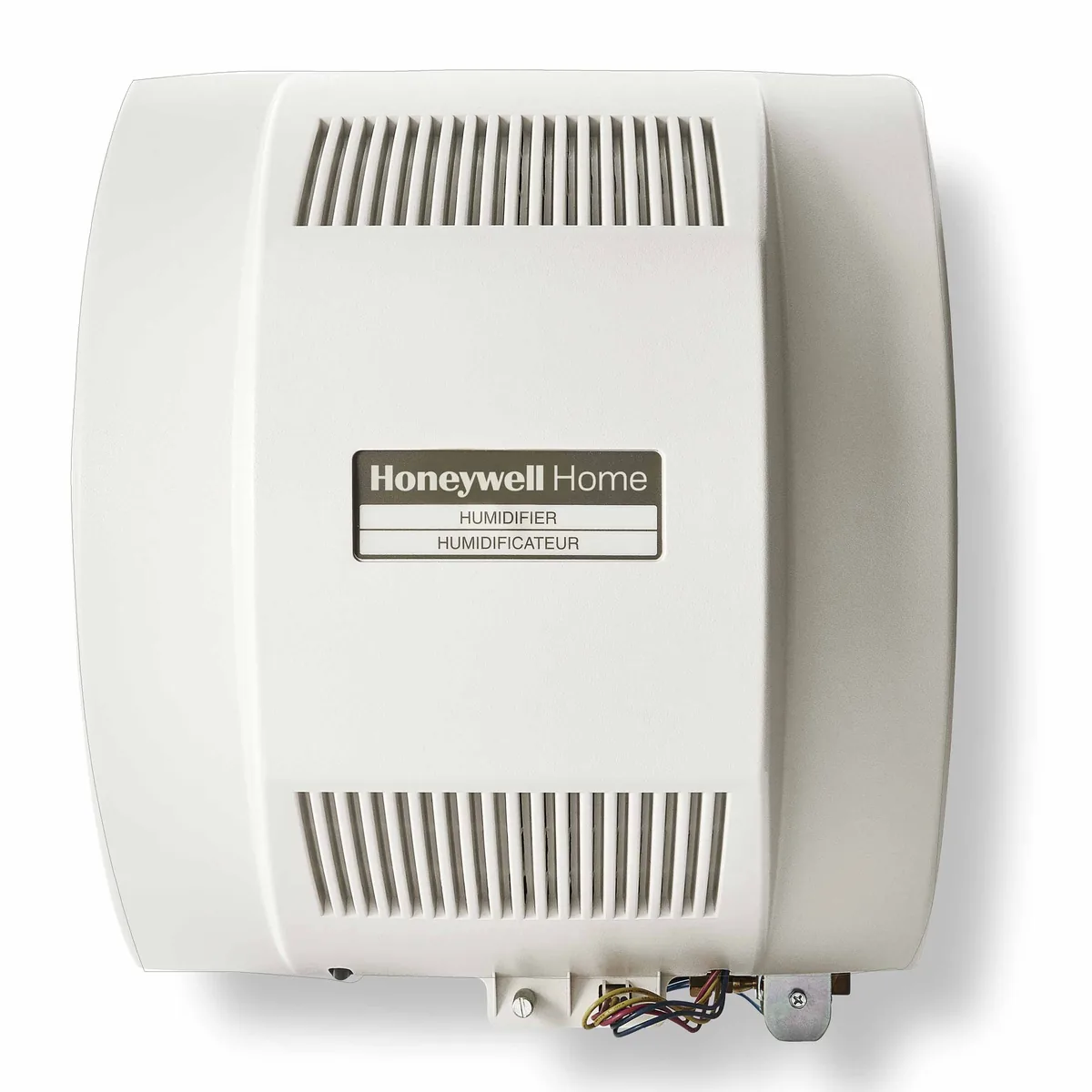
Honeywell HE360 Fan-Powered
Eighteen gallons a day against a published 4,500 sq ft - almost exactly what the load calculation says 18 gal/day supports, which makes this the most precisely honest coverage claim of any whole-house unit here. Like the Aprilaire 700 it carries its own blower, so it humidifies on mild days when a bypass unit sits idle, and Honeywell specifically recommends it with variable-speed and multi-stage furnaces where the burner cycles less. It undercuts the Aprilaire 700 by $60 on hardware.
4,434 sq ft supported · box says 4,500 sq ft
Aprilaire
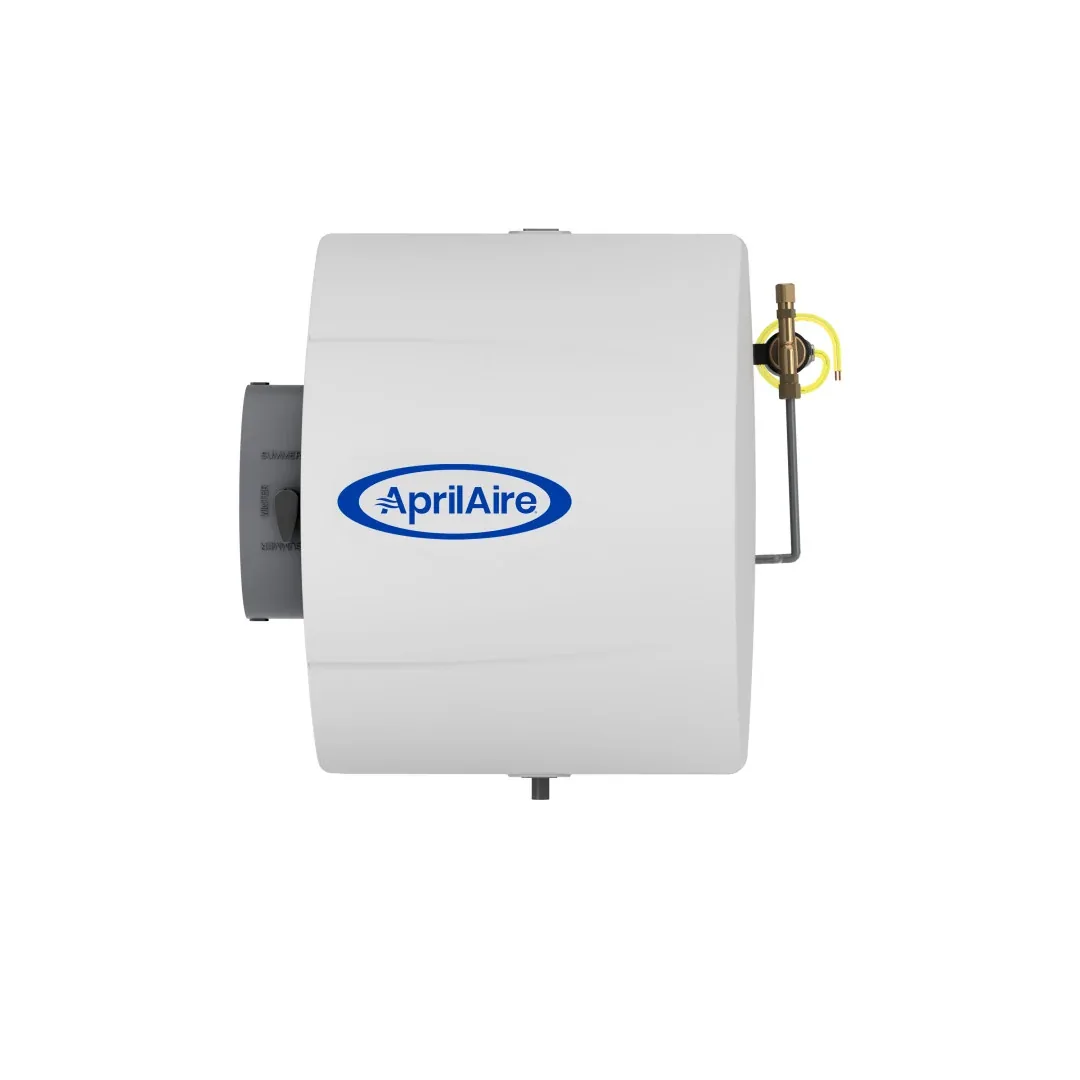
Aprilaire 600 Bypass
The best-selling whole-house humidifier in North America, and the default recommendation from most HVAC contractors for a reason: seventeen gallons a day for $220 of hardware and $25 a year of water panels. The published 5,000 sq ft is the tight-construction figure, and Aprilaire says plainly that an average home of about 2,000 to 2,500 sq ft is the realistic target - a maker volunteering that its headline number applies to a minority of houses. The load calculation puts 17 gal/day at around 4,200 sq ft, neatly between Aprilaire's own two figures.
4,188 sq ft supported · box says 5,000 sq ft
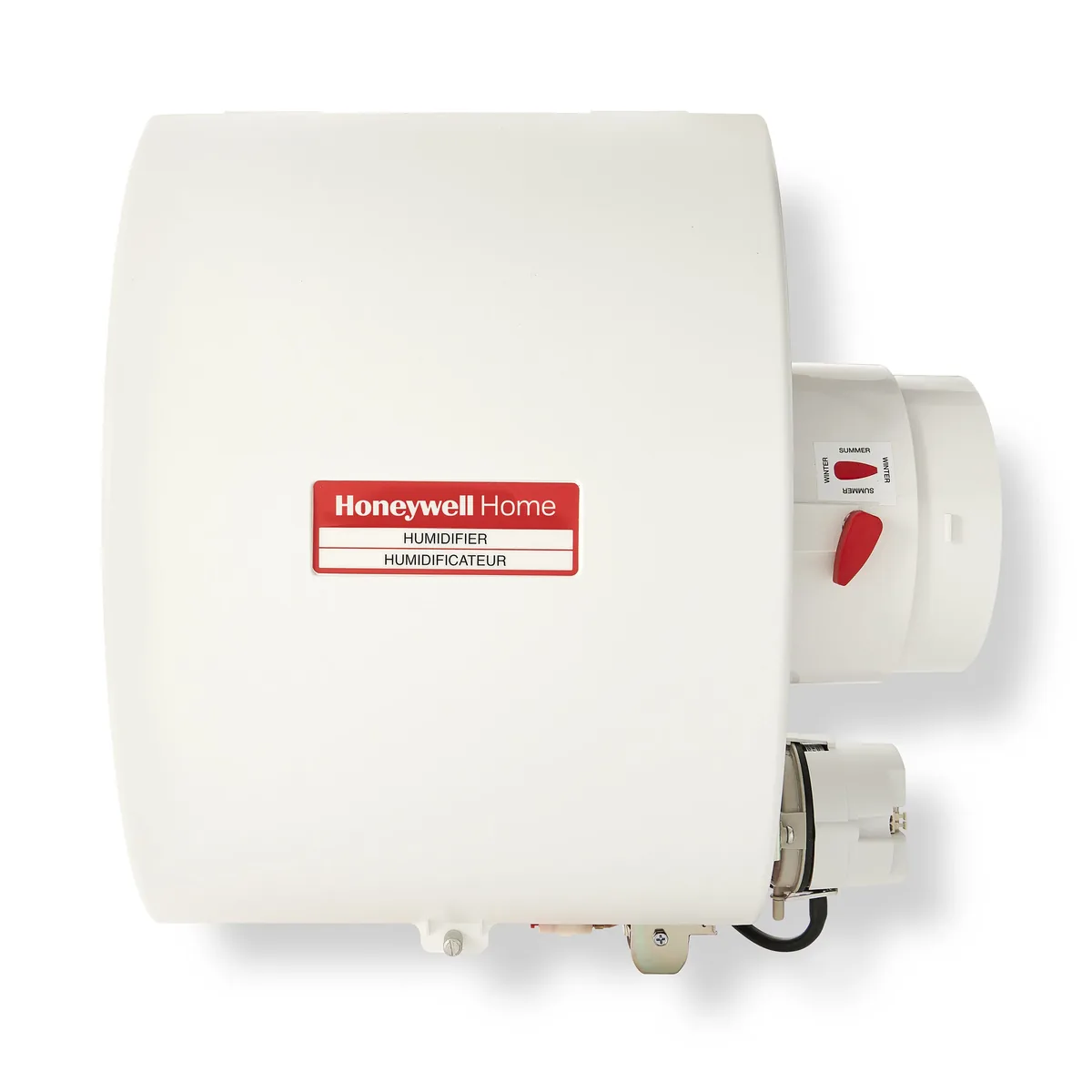
Honeywell
Honeywell HE280 Bypass
Honeywell's direct answer to the Aprilaire 600, matching it at seventeen gallons a day, and the only unit in this catalog that states its coverage in cubic feet rather than square feet - 18,000 of them, which at an eight-foot ceiling is 2,250 sq ft. That is a notably conservative way to quote a machine whose output supports around 4,200, and it is the correct unit to use, since humidity fills a volume rather than a floor. The PerfectFLO tray meters water onto the pad instead of flooding it, which is where the water-saving claim comes from.
4,188 sq ft supported · box says 2,250 sq ft
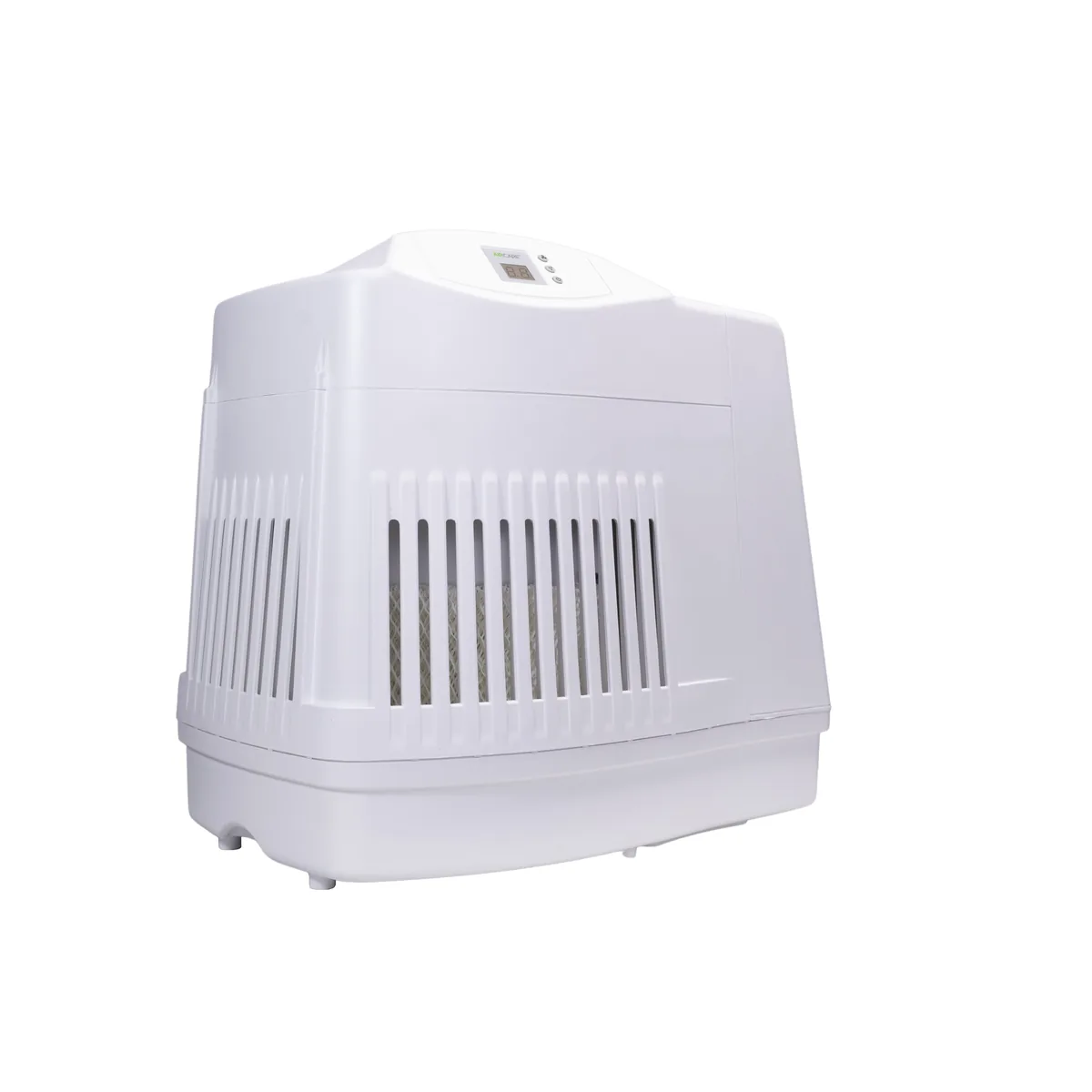
AIRCARE
AIRCARE MA1201 Console
Twelve gallons a day is more than any other portable in this catalog by a factor of three, and it is the reason people with genuinely dry old houses end up here rather than buying four bedroom units. The load calculation puts 12 gal/day at around 2,950 square feet against AIRCARE's 3,600 - an overstatement of about a fifth, which in this category counts as restraint. The number that surprises people is the tank: 3.6 gallons feeding 12 gallons a day is roughly seven hours at full output. The 36-hour figure is the lowest of four speeds. Owners of dry houses fill this thing twice a day in January and consider it worth it.
2,956 sq ft supported · box says 3,600 sq ft
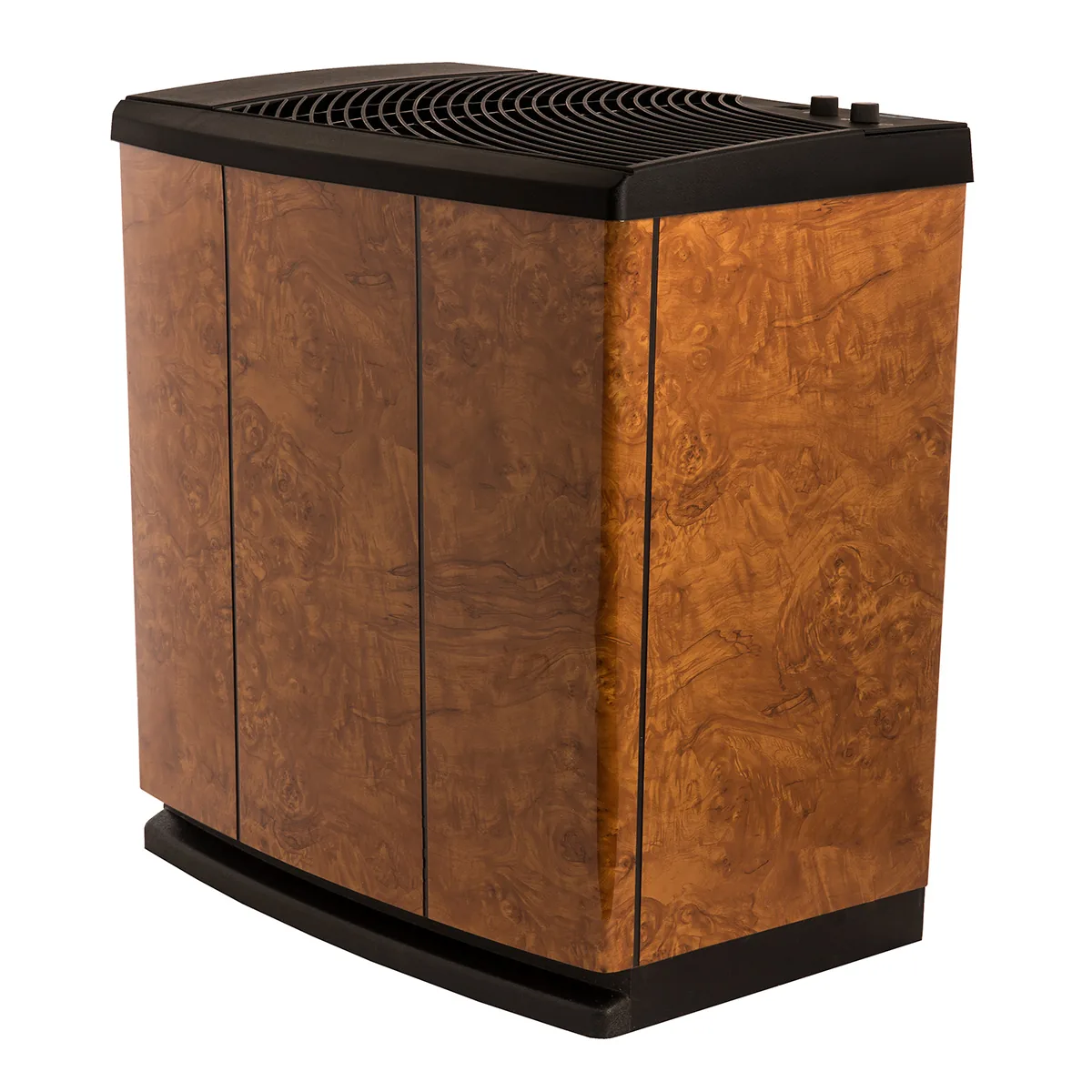
AIRCARE
AIRCARE H12-400HB Credenza
The MA1201's output in a credenza cabinet with half again as much water, which is the version of this machine that makes sense for a house you actually live in. Same 12 gallons a day, but 5.4 gallons of reservoir stretches the fill interval from seven hours to eleven at full tilt, and four speeds with an auto humidistat mean it rarely runs at full tilt. It is heavy, it is furniture, and at $280 it is the most expensive portable here - but it does a job that otherwise requires a plumber and a hole in your ductwork.
2,956 sq ft supported · box says 3,700 sq ft
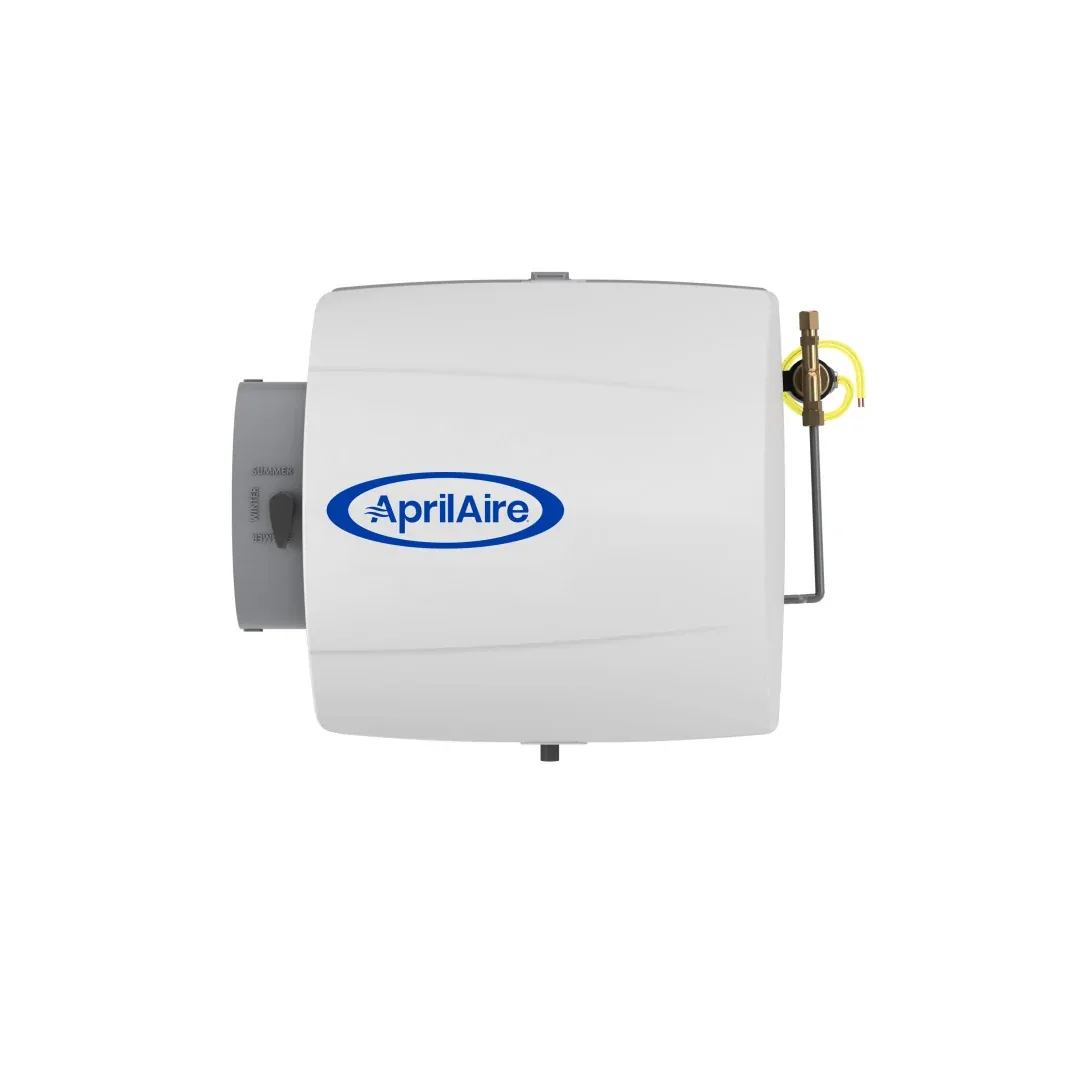
Aprilaire
Aprilaire 500 Bypass
Bolted to the ductwork, plumbed to a water line, and never filled by hand again - that is the entire argument for going whole-house, and the Aprilaire 500 is the small end of it. A bypass humidifier borrows warm air from the supply duct, passes it through a wet evaporator panel, and returns it to the return duct; it only humidifies while the furnace is running, which is its main limitation. Twelve gallons a day matches the biggest portable console in this catalog, and the 3,600 sq ft claim sits about a fifth above what the load calculation supports. Aprilaire publishes separate figures for tight, average and loose construction, which is a more honest way to state coverage than anyone selling a plug-in unit manages.
2,956 sq ft supported · box says 3,600 sq ft
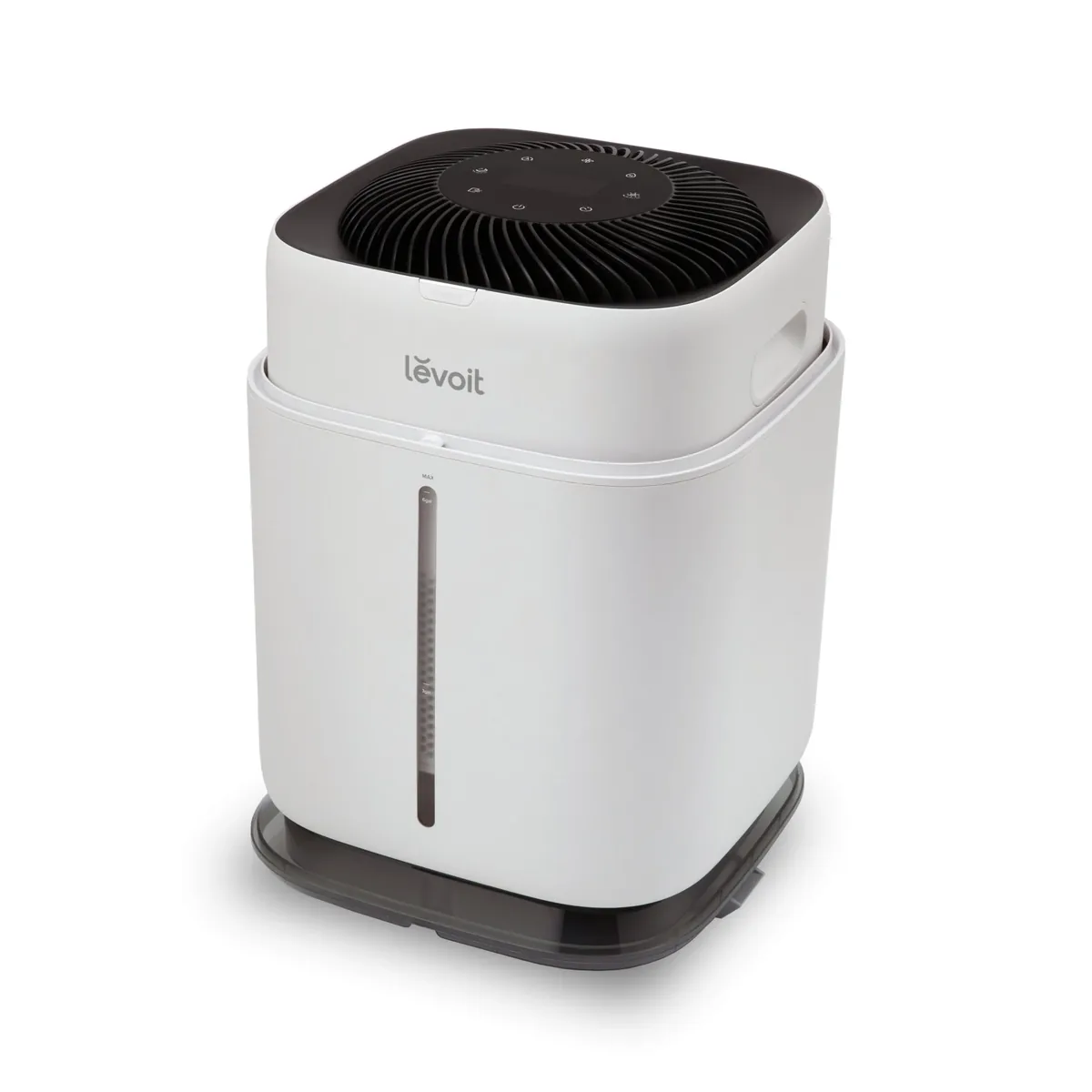
Levoit
Levoit Superior 6000S
This is what happens when Levoit stops building ultrasonics. A 1,500 mL/hr published output works out to 9.5 gallons a day, which is console territory, and because it evaporates water through wicks rather than atomising it there is no white dust and no mineral film on the furniture. The 3,000 sq ft claim is one of the more defensible in the catalog: the physics supports around 2,300, so it overstates by about a third rather than the three- and four-fold gaps common among the ultrasonics. The cost is a wick habit - four of them, around $40 a set - and a unit you fill through a hose and funnel rather than lifting a tank. Owners who moved from an ultrasonic mostly describe the absence of dust as the thing they noticed first.
2,343 sq ft supported · box says 3,000 sq ft
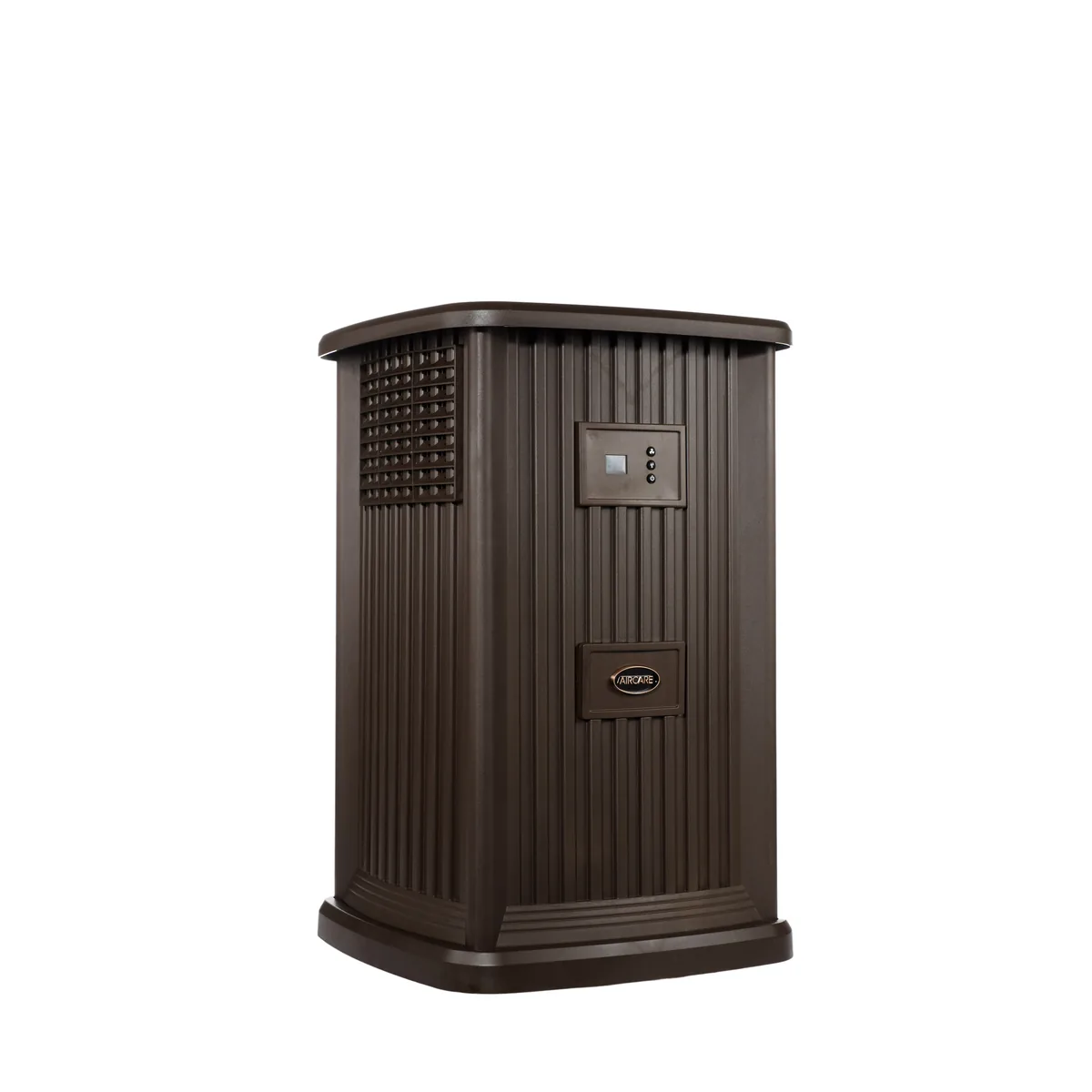
AIRCARE
AIRCARE EP9800 Pedestal
AIRCARE's concession to the fact that a console humidifier is a large brown box in a living room. The EP9800 is the same machinery in a pedestal cabinet with a wood finish, meant to look like furniture rather than an appliance - and it half succeeds, which is more than the MA1201 attempts. Nine fan speeds is genuinely useful granularity when you are trying to find the setting that is quiet enough to live with. Output is 7.4 gallons a day against a 2,400 sq ft claim; the calculation supports about 1,820, so it overstates by a third.
1,823 sq ft supported · box says 2,400 sq ft
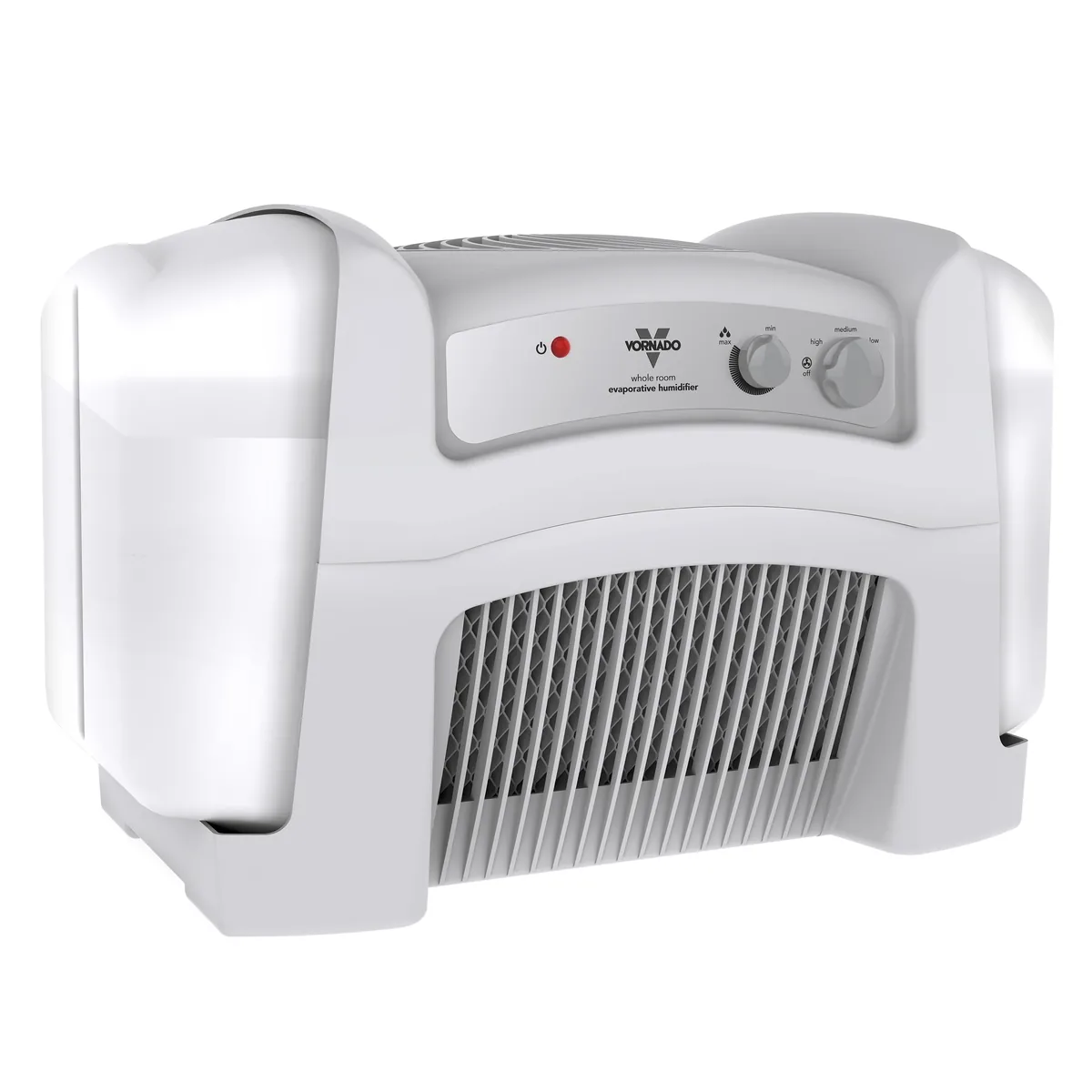
Vornado
Vornado Evap40
Four gallons of water, four gallons a day of output, a full day between fills at the top speed, and a 1,000 sq ft claim that the load calculation puts at 985. Vornado states the runtime honestly too - four gallons in 24 hours run continuously on high - which is the sentence almost nobody else in this category is willing to write. It is the smallest true console here and the one to buy if the AIRCARE units are more furniture than a room can take. Made in the USA, five-year guarantee, and still just a fan blowing through two wet wicks.
985 sq ft supported · box says 1,000 sq ft
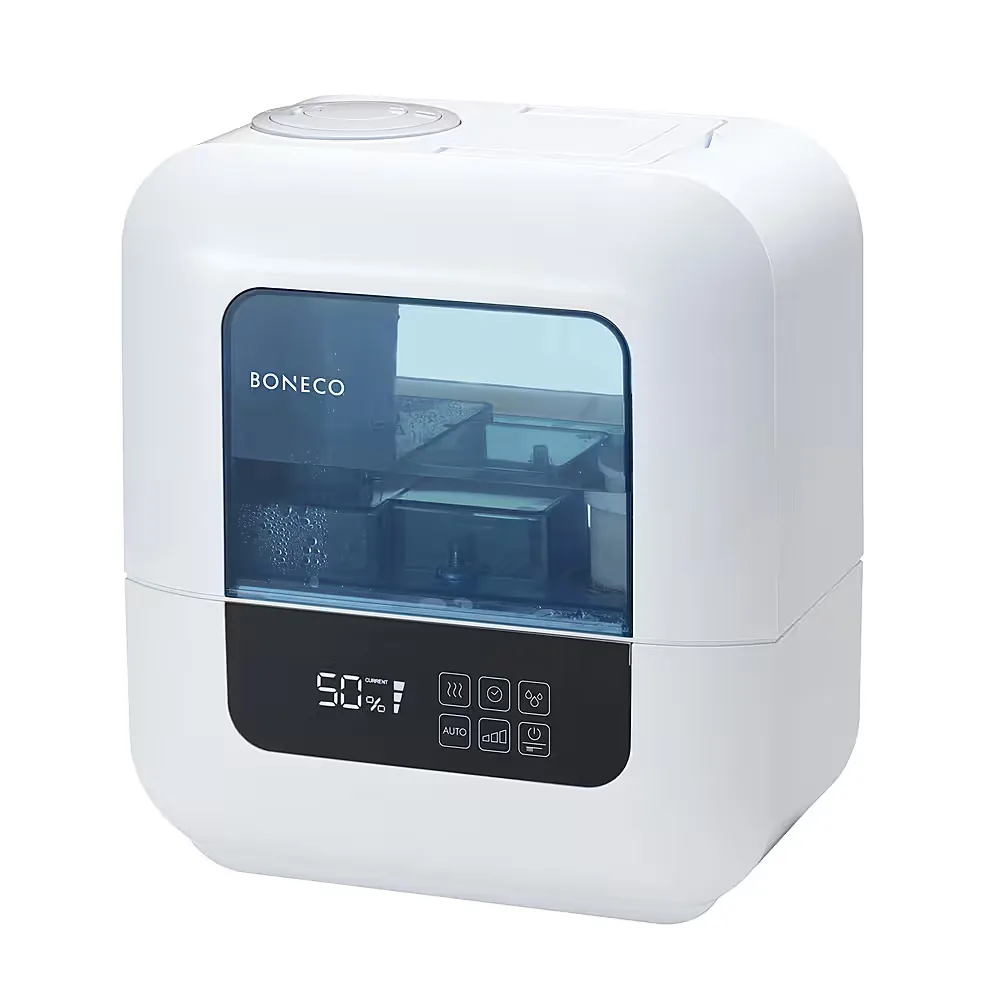
Boneco
Boneco U700
Four gallons a day from a tabletop unit, which puts the U700 level with Vornado's Evap40 console on output while taking up a fraction of the floor. Its 1,000 sq ft figure lands within two percent of the load calculation - Boneco and Vornado are the two brands here whose marketing numbers and physics agree. Nine litres is the largest tank of any tabletop unit in the catalog and still only fourteen hours at full tilt, which is the recurring lesson of this category: capability and refill interval trade against each other and no amount of marketing changes it. The self-cleaning mode is genuinely unusual at any price.
985 sq ft supported · box says 1,000 sq ft
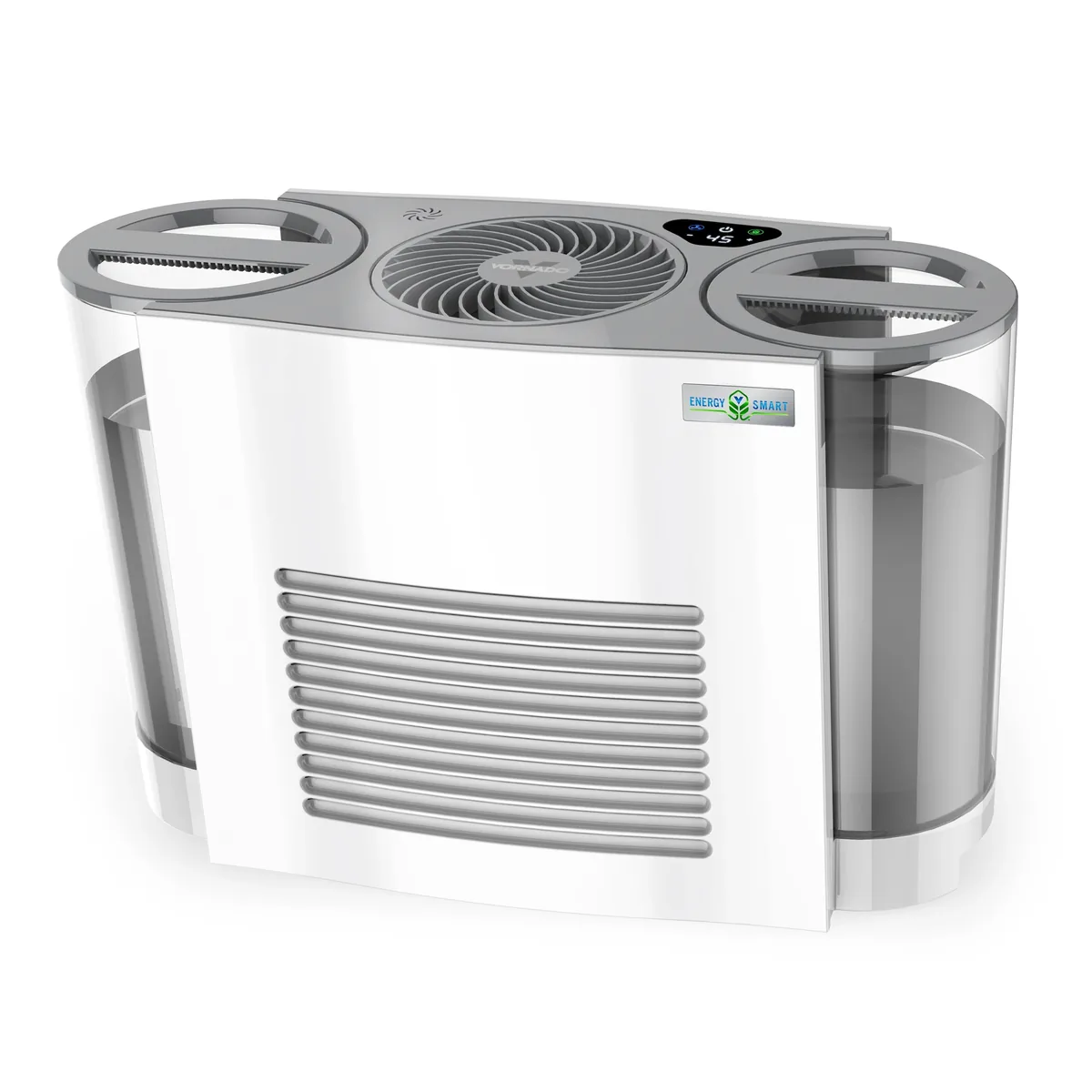
Vornado
Vornado EVDC500 Energy Smart
The EVDC300's larger sibling: same DC motor and single-watt idle, two tanks instead of one, and enough output to matter in a real living room. At 3.5 gallons a day it is the most capable portable Vornado makes, and its 850 sq ft figure again sits within a few percent of the load calculation. Fourteen hours at full output, so still a daily job in a dry house - but two tanks make that a lighter job than one. The question it poses against the Evap40 console is whether you would rather carry water twice a day and keep the floor space, or once a day and give up a corner.
862 sq ft supported · box says 850 sq ft
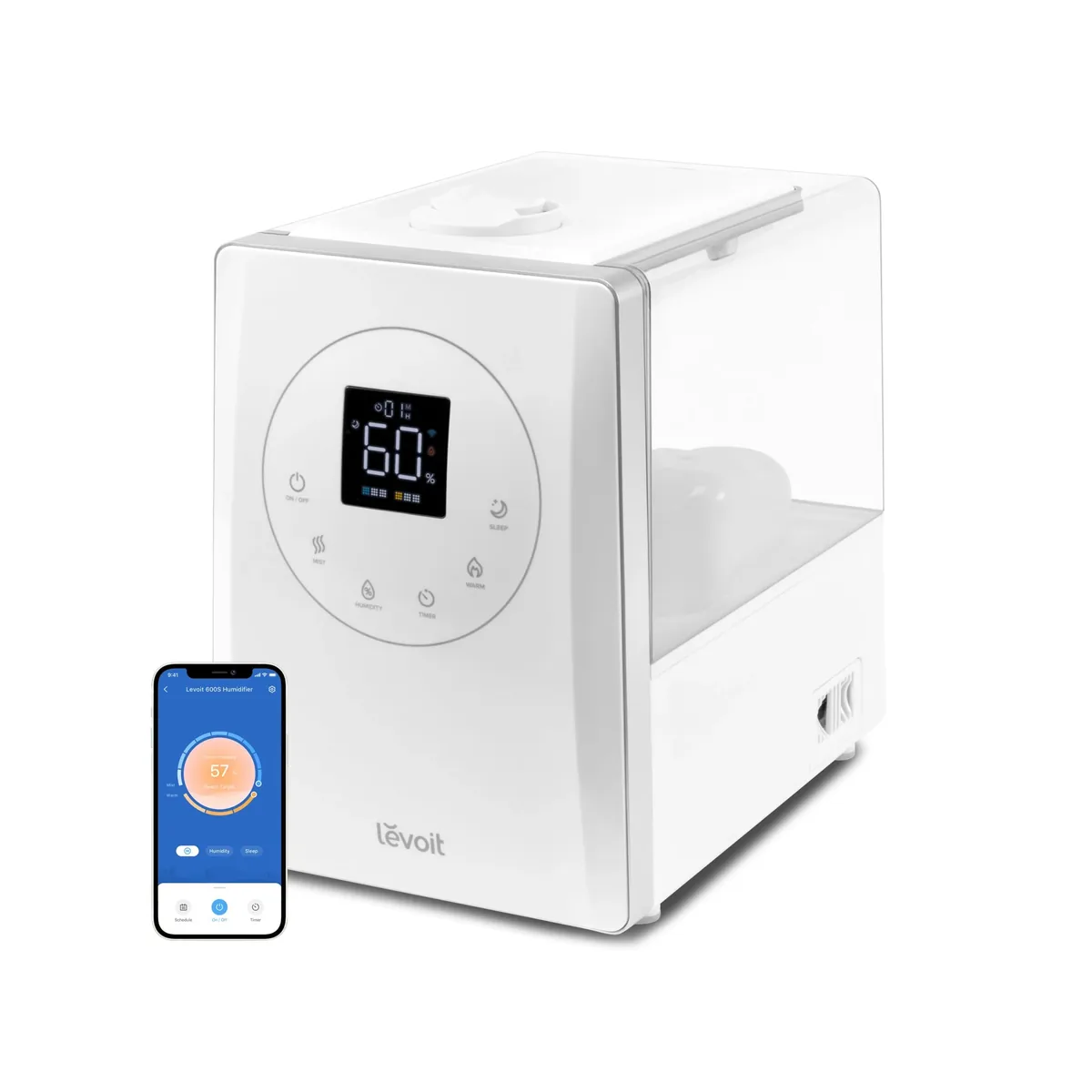
Levoit
Levoit LV600S
One of the few units in the catalog where the maker publishes an actual output rate rather than leaving you to infer it: 500 mL/hr on warm, 300 on cool. That makes the LV600S checkable in a way most of its shelf-mates are not, and the check is unflattering in a useful way. At 500 mL/hr it moves 3.17 gallons a day, which is a genuinely capable figure - enough for around 780 square feet by the psychrometrics - but it empties the 6L tank in about twelve hours. The 50-hour runtime on the box is the cool setting at its lowest. Both numbers are honest; they just describe different machines. Owners who understand that and run it on auto in a bedroom are happy; owners who expected 50 hours of whole-floor humidification are the ones writing the angry reviews.
781 sq ft supported · box says 753 sq ft
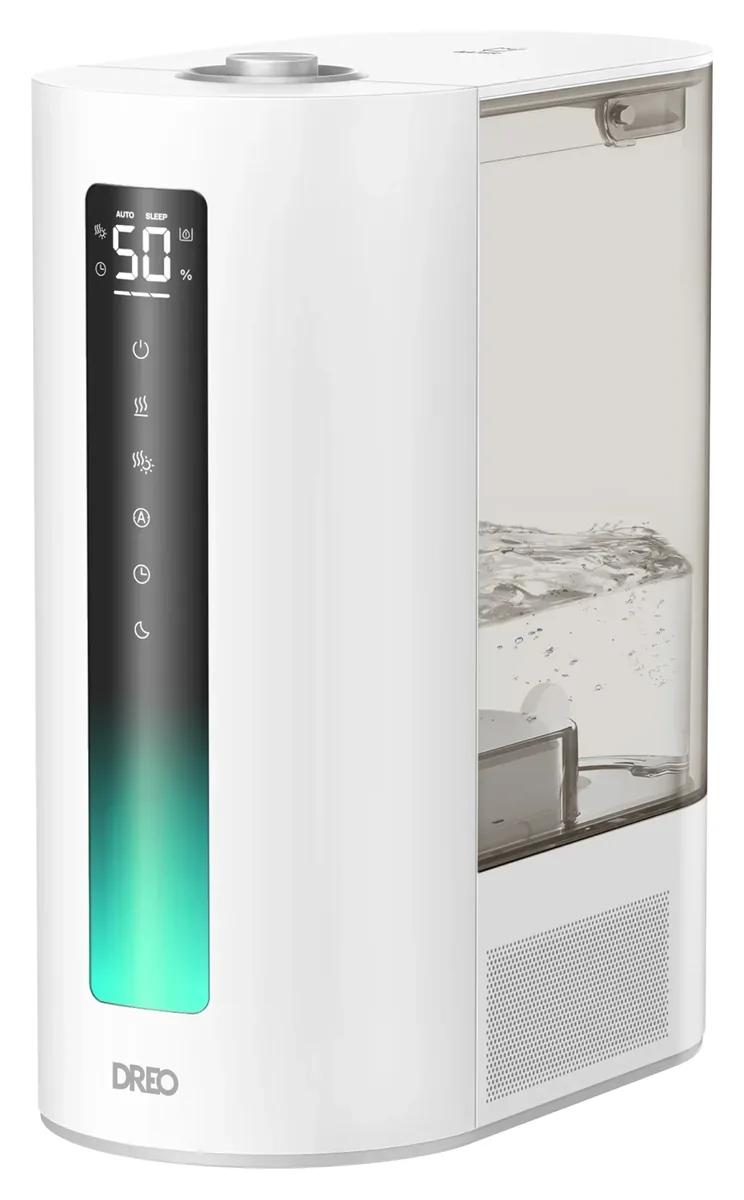
Dreo
Dreo HM713S
Dreo publishes 500 mL/hr for this one, which is 3.17 gallons a day and puts it in the same real-output bracket as Levoit's LV600S at a slightly lower price. It also keeps the demineralisation cartridge, so unlike the Levoit it can run tap water without decorating the room. The 550 sq ft claim is close to what 3.17 gal/day actually supports - around 780 by the psychrometrics - making this one of the few portable ultrasonics whose room-size number is conservative rather than aspirational. The catch is the same as every hybrid: at the output that justifies the claim, the 6-litre tank is empty in about twelve hours.
781 sq ft supported · box says 550 sq ft
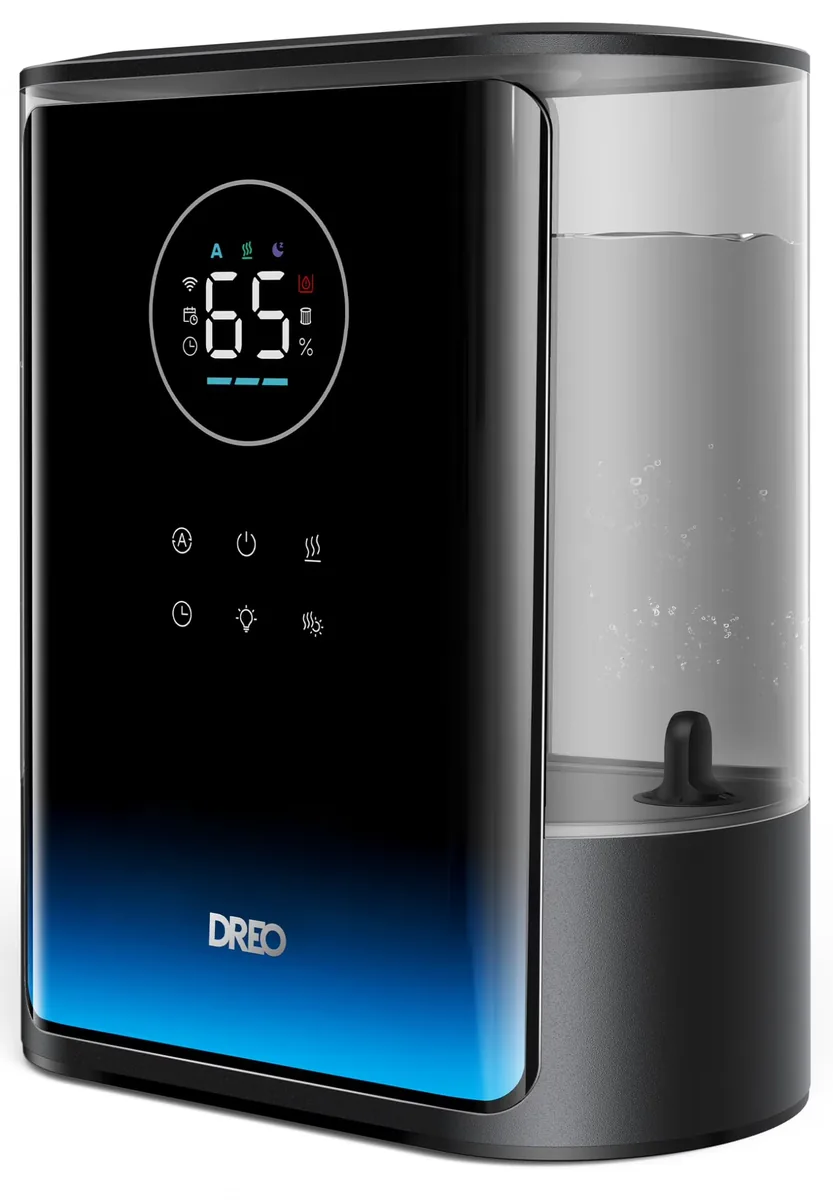
Dreo
Dreo HM717S
Eight litres, warm and cool mist, a published 500 mL/hr, and a demineralisation cartridge - on paper the most complete portable in Dreo's line. The extra two litres over the HM713S buy about four more hours at full output rather than the twenty the runtime figures suggest, because the 80-hour number is again the lowest setting. Where it genuinely earns the money is the middle: run it on auto in a 400 sq ft bedroom and it will go two or three nights between fills without a chilly mist or a dusty dresser.
781 sq ft supported · box says 600 sq ft
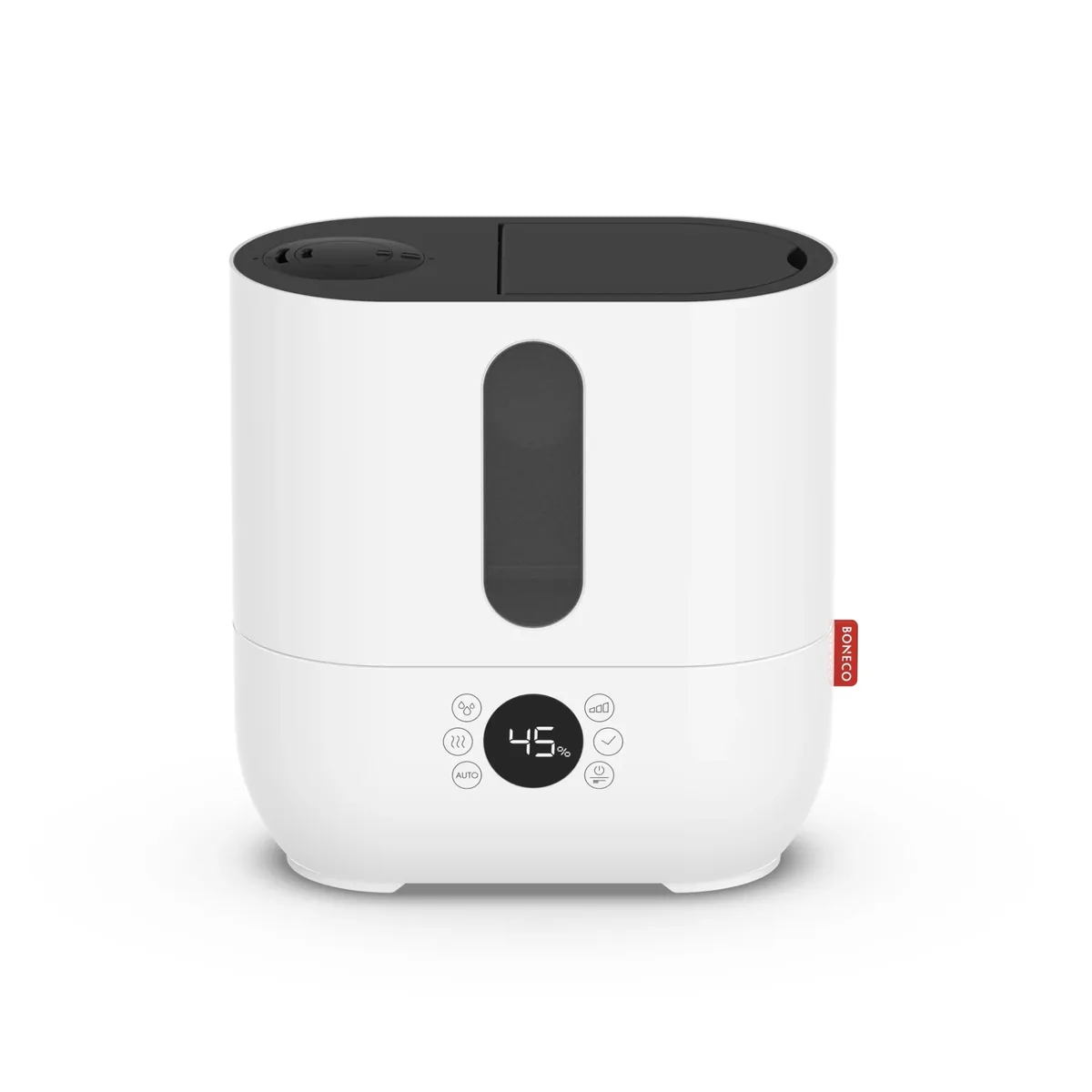
Boneco
Boneco U350
Swiss, expensive, and unusually straight about what it does: 3.17 gallons a day published, against a 650 sq ft claim that the load calculation puts at 780. A maker printing a number 17% below what its own output supports is doing something almost nobody else in this catalog does. It pairs a demineralisation cartridge with an Ionic Silver Stick for the water, so the two failure modes of a cheap ultrasonic - dust on the furniture, life in the tank - both have a specific countermeasure. The tank is only 5 litres, which at full output is about ten hours.
781 sq ft supported · box says 650 sq ft
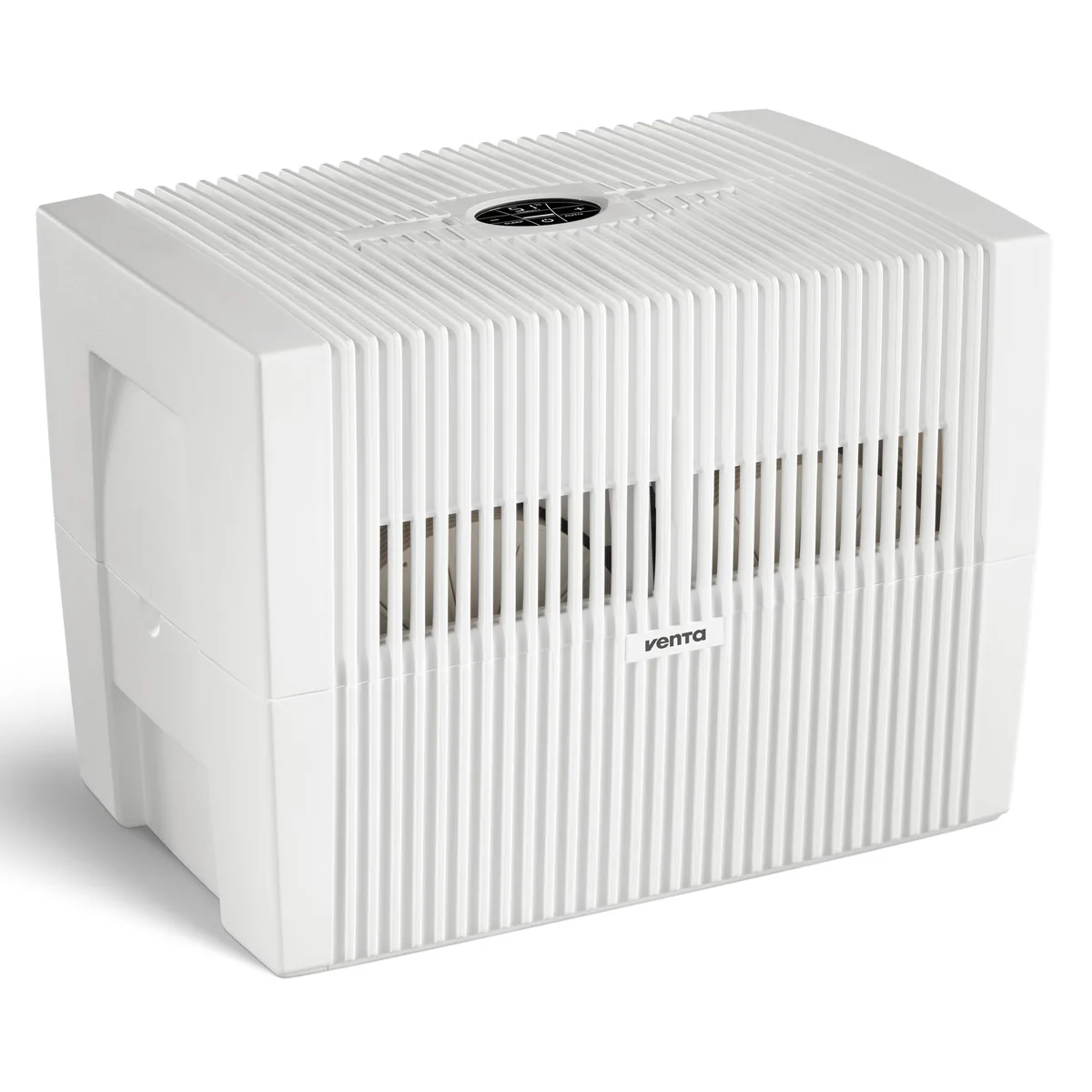
The LW25's larger sibling, and the one where Venta does publish a figure: three gallons a day from a three-gallon reservoir, which is a true 24 hours between fills at full output. That is a rare and honest pairing - almost every unit in this catalog quotes a runtime from one setting and a room size from another. Three gallons a day supports about 740 square feet against Venta's 645, so the claim is conservative. Eight watts, no wick, ten-year warranty, and a basin you will have your hands in every couple of weeks.
739 sq ft supported · box says 645 sq ft
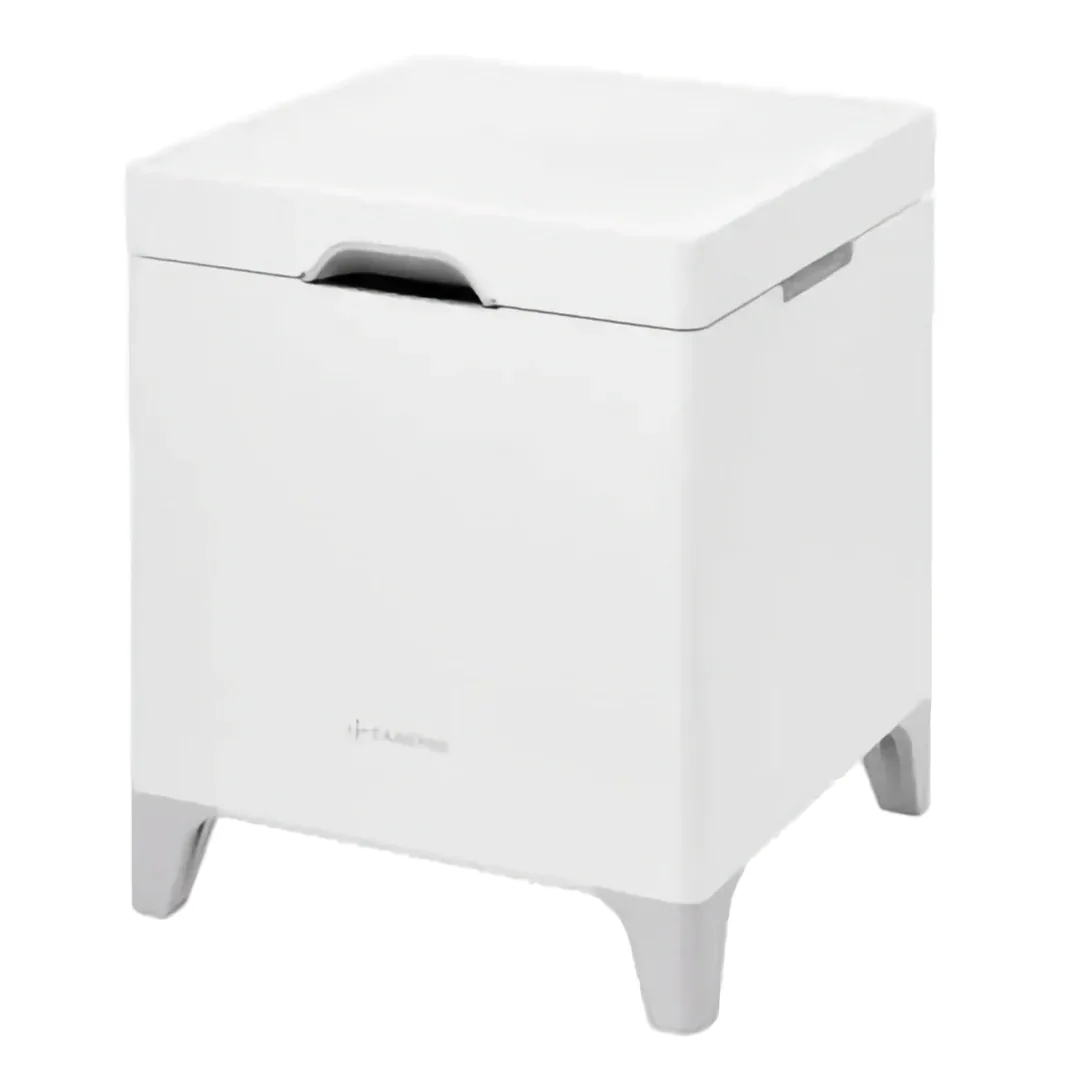
Carepod
Carepod Cube Plus X50V
The One Plus with a heater, which buys warm mist and - more interestingly - a one-touch cycle that boils the tank to sterilise it. Between a steel water path and a heat-sanitise button, this is as close as the category gets to solving the hygiene problem outright, and it is priced accordingly at $450. Carepod buries its output rate in a feature graphic rather than a spec table, which is a shame because it is one of the better ones here: 440 mL/h on warm is 2.79 gallons a day, and that makes the 700 sq ft on the listing very nearly honest. The catch is the tank. At that output 4.2 litres is gone in about ten hours, against the 32 advertised at the lowest setting.
687 sq ft supported · box says 700 sq ft
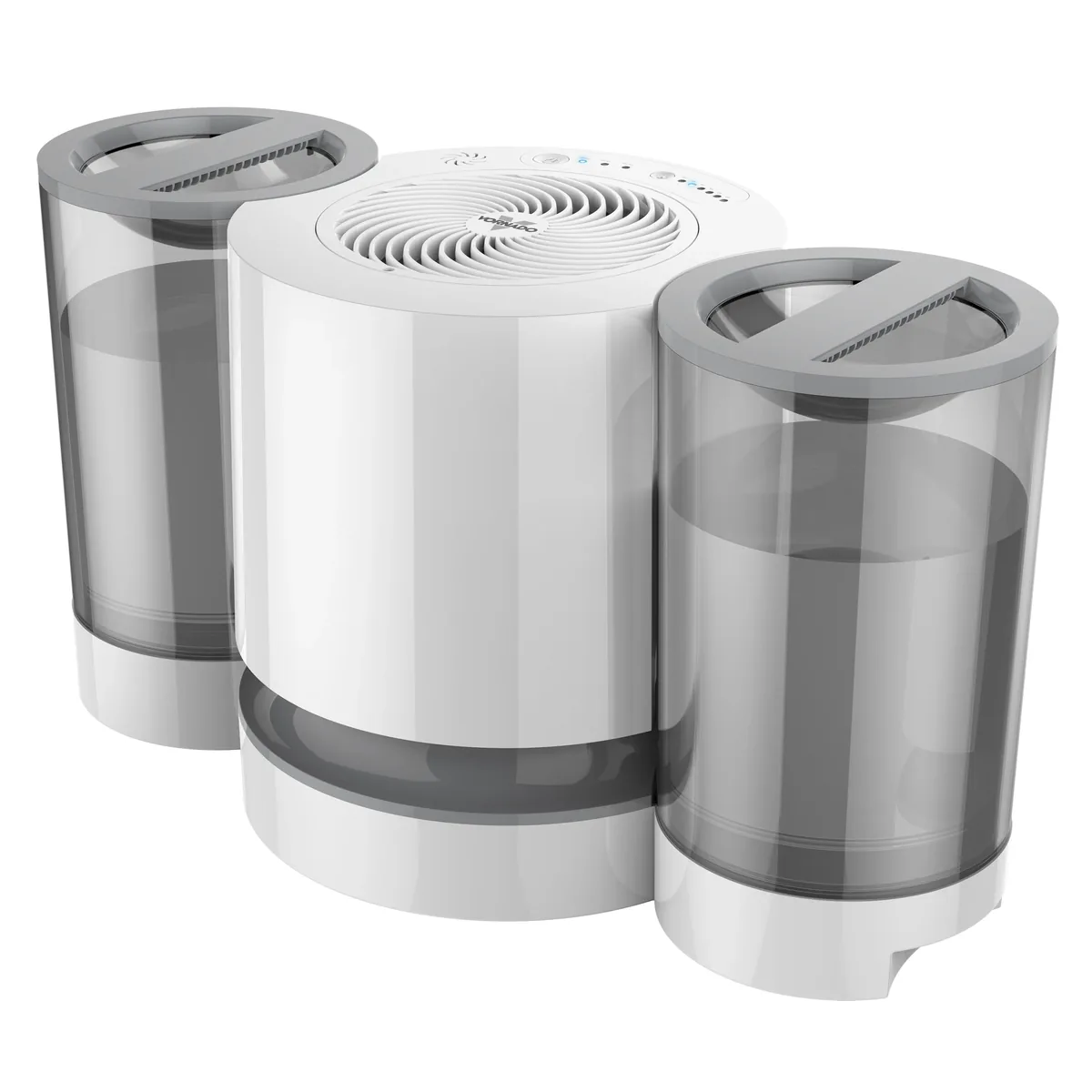
Vornado
Vornado EV200
Two tanks instead of one, two wicks instead of one, and 2.4 gallons a day against a 580 sq ft claim - the closest match between a maker's number and the load calculation anywhere in this catalog, off by about two percent. Refilling means carrying two 0.75-gallon tanks rather than one heavy one, which sounds like a downgrade and is not: most people find two light trips easier than one awkward one, and you can run it on a single tank overnight. Fifteen hours at full output is the honest tank life, and Vornado does not pretend otherwise.
591 sq ft supported · box says 580 sq ft
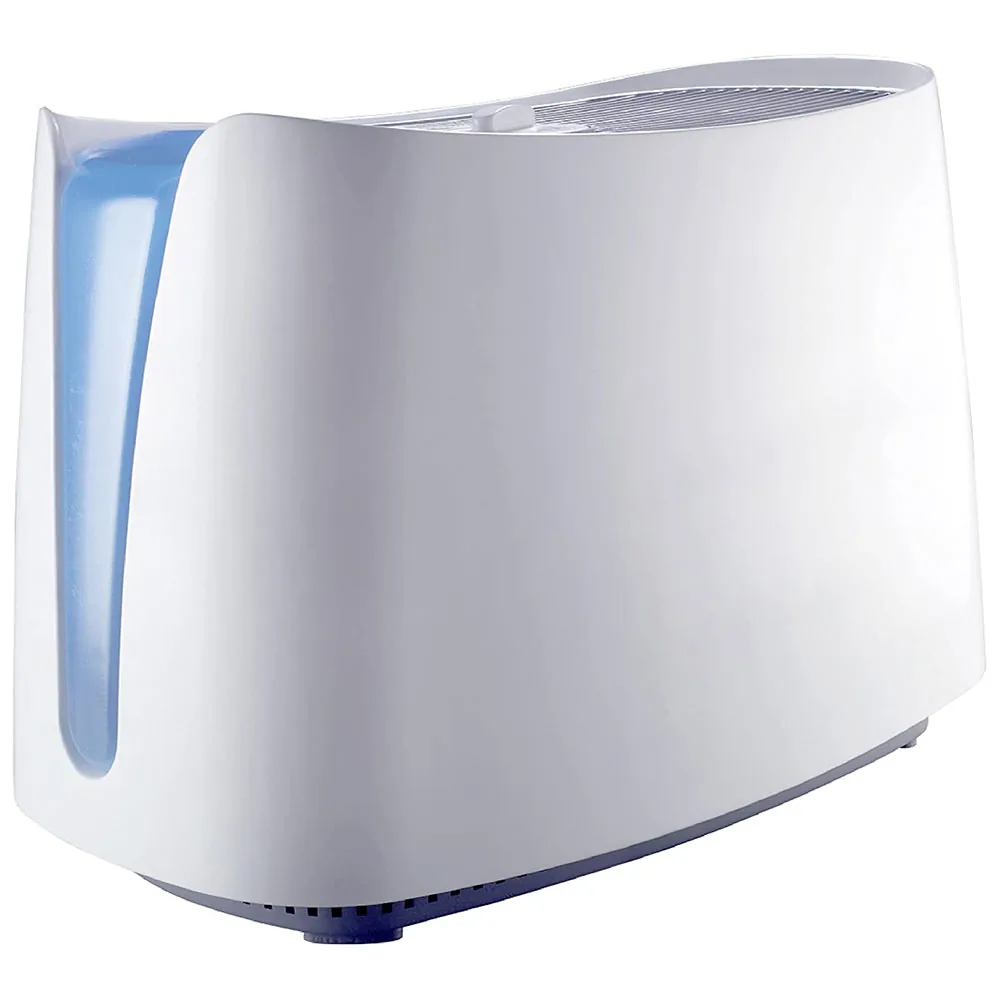
The long-running default recommendation in this category, and the arithmetic explains why. Honeywell publishes 2.3 gallons a day against a 500 sq ft claim - a room that actually needs about 2 gallons a day - making this one of the only portable humidifiers in the catalog whose coverage number the physics supports outright. It has been on sale since 2011 largely unchanged, the tank and several parts go in the dishwasher, and it evaporates rather than atomises, so there is no white dust. The costs are a wick habit, a fan you can hear, and no humidistat at all: three speeds, and you are the humidistat.
567 sq ft supported · box says 500 sq ft
Vornado
Vornado EVDC300 Energy Smart
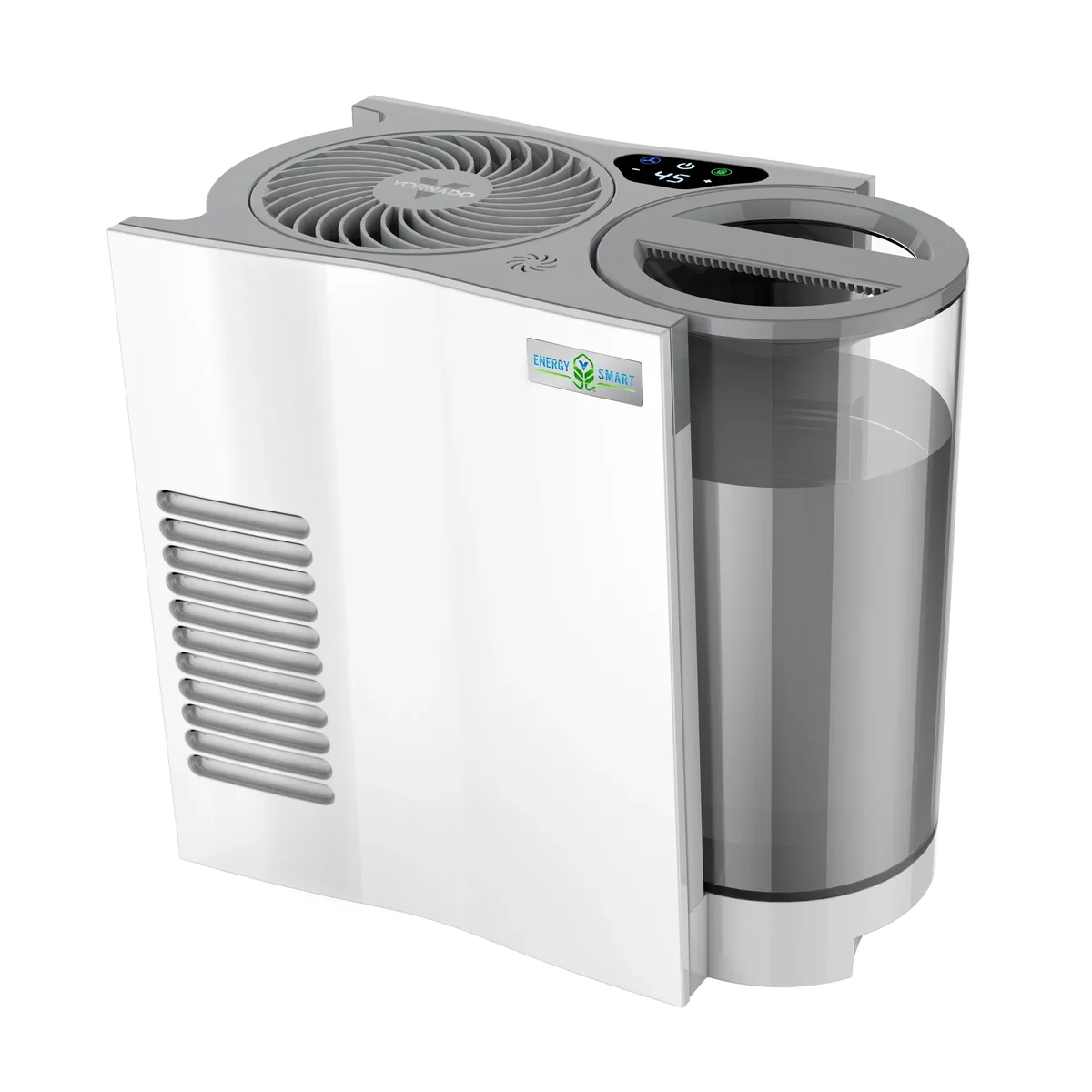
A DC motor is the only interesting thing here and it is interesting enough to justify the model. On its Energy Smart setting the EVDC300 draws as little as a single watt, against the twenty to forty a comparable AC evaporative pulls, and it runs the whole winter for the price of a few coffees. Output is 2.3 gallons a day - within one percent of what its 560 sq ft claim actually needs - from a one-gallon tank, which is the catch: ten hours between fills if you run it hard. It is the fill interval, not the capability, that decides whether this or the two-tank EV200 is the right one.
567 sq ft supported · box says 560 sq ft
Boneco
Boneco W200 Air Washer
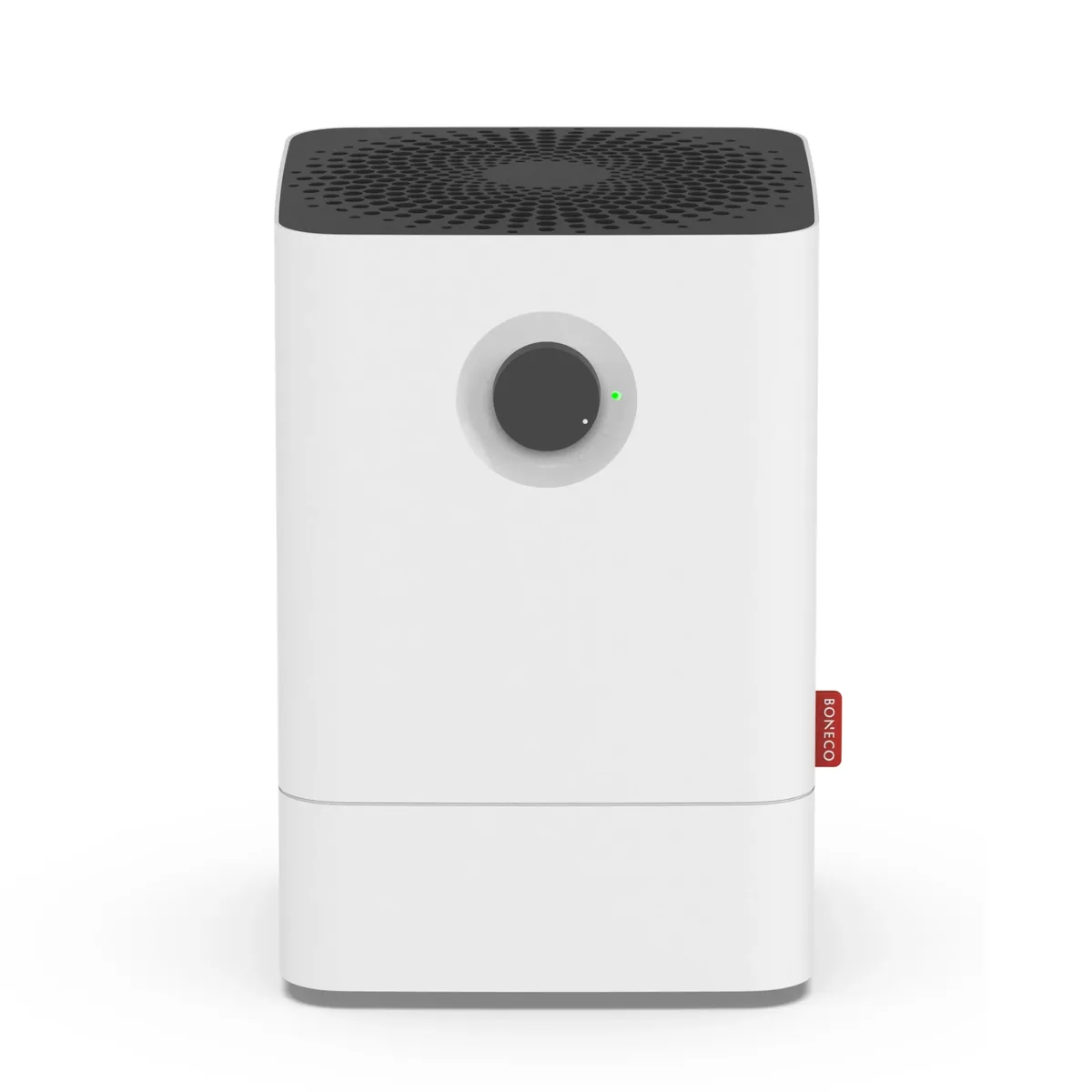
An air washer works by spinning a stack of plastic discs through a water bath: air passes over the wet surfaces, picks up moisture, and drops some dust on the way. The appeal is that there is no wick to buy - ever - because the discs are permanent and go in the dishwasher. Boneco's technical data gives 350 grams an hour, which is 2.22 gallons a day and supports about 547 sq ft, so the 540 on the listing is one of the few coverage claims in this catalog that its own maker's output figure actually backs. The rest of the arithmetic is as plain: a 4.5-litre bath, one silver stick a year, no filters, and about thirteen hours between fills if you are running it at the room it claims.
547 sq ft supported · box says 540 sq ft
Honeywell
Honeywell HEV620 Top Fill Tower
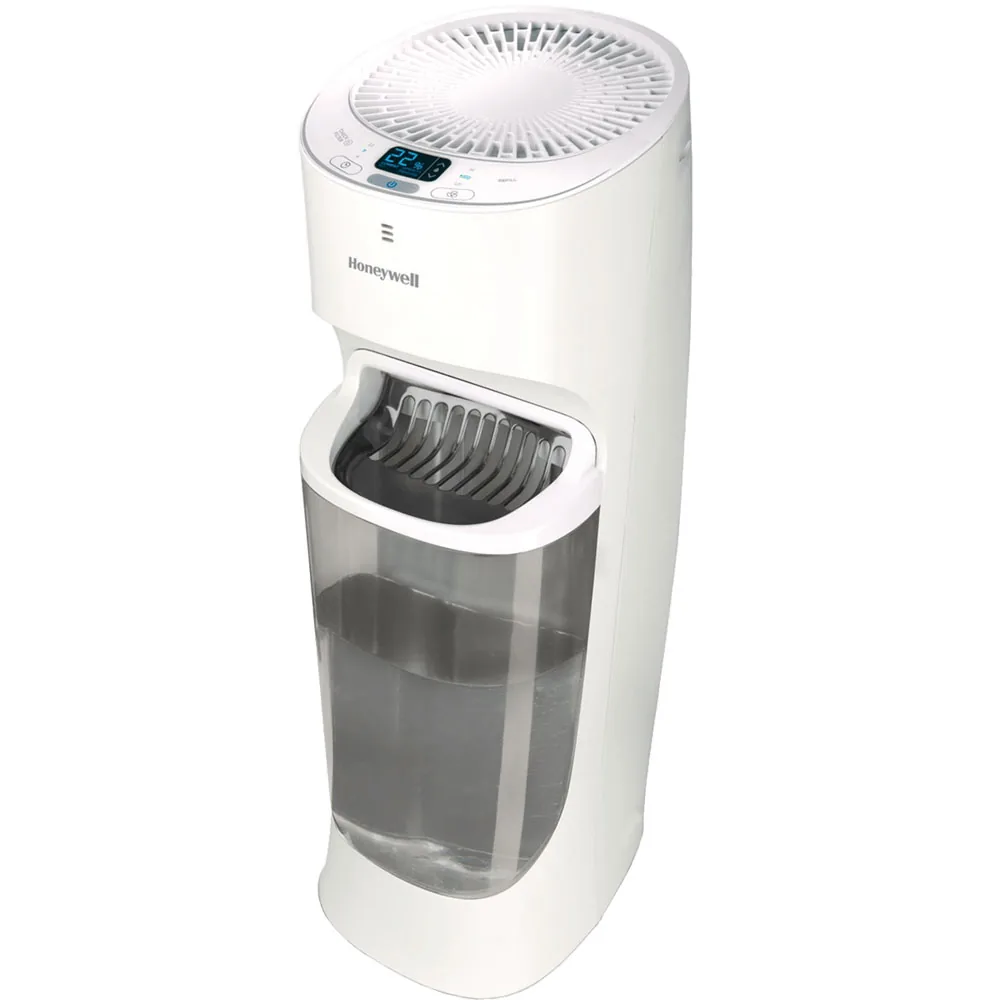
Honeywell's answer to the two complaints levelled at the HCM-350: no digital humidistat, and a tank you have to carry upside down to the sink. The HEV620 is a tower with a top-fill opening, a digital humidistat that will actually hold a target, and a timer. Its 300 sq ft claim against 2 gallons a day of output is the most conservative ratio in the entire catalog - the output supports closer to 490 - which is worth knowing if you have been talked out of it by a spec-sheet comparison against an ultrasonic promising 750.
493 sq ft supported · box says 300 sq ft
What people ask before the first one arrives
Straight answers to the things owner discussions keep circling back to.
How big a room will a humidifier actually cover?
Roughly 246 square feet for every gallon per day of output, at 8-foot ceilings and normal winter conditions. That number comes out of the standard moisture-load calculation, and it is not what most cartons say — a typical bedroom ultrasonic delivering half a gallon a day will be marked 500 square feet when the physics supports about 123. The quickest sanity check needs no output figure at all: divide the tank size by the room's square footage times 0.004, and if the answer is less than a day, the unit cannot hold that room without you refilling it constantly. The calculation in full →
Why do humidifier runtime and coverage claims contradict each other?
Because they are measured at opposite ends of the same dial. The runtime figure — 'up to 60 hours' — is taken on the lowest mist setting, where the unit uses the least water. The coverage figure — 'up to 505 sq ft' — describes what it can do at the highest. Both are true and they never apply at the same moment. Reconciling them is the single most useful thing you can do with a spec sheet, and every unit on this site shows the result. Ranked by honest refill interval →
Is there an AHAM rating for humidifiers, like CADR for air purifiers?
No. AHAM certifies room air cleaners, dehumidifiers and room air conditioners, and publishes searchable directories for them — but there is no AHAM directory of certified humidifiers. There is a published test method, AHAM HU-1, that a maker may choose to measure against, but nobody independently verifies or publishes the result. Every output and coverage number in this category is the maker's own, unrefereed. Where our numbers come from →
What is white dust and which humidifiers avoid it?
Calcium and magnesium from tap water, atomised into the room and settling on furniture. Only ultrasonic and hybrid units can produce it, because only they turn liquid water into airborne droplets. Evaporative, steam and whole-house units leave the minerals behind in the wick or the boiling chamber, so they cannot do it whatever you fill them with. An ultrasonic with a demineralisation cartridge is also safe, as long as you keep replacing the cartridge. All 35 units that cannot make dust →
What humidity level should I set in winter?
Between 30% and 50%, and toward the lower end as it gets colder outside. Below 30% is where static, dry airways and cracking woodwork start; above 50% is where dust mites get comfortable. The practical ceiling in a cold snap is whatever your windows will tolerate — once water is pooling on the sill rather than fogging the glass, the setting is too high for the building, regardless of what the number says. Setting it properly →
What is the pink stuff that grows in the tank?
Serratia marcescens, a bacterium that lives in household dust and colonises standing water quickly. It is nearly universal and it is a cleaning-interval problem, not a defect. The habit that prevents it is emptying and drying the tank between fills rather than topping it up, and the feature that makes that habit stick is a tank you can get your hand inside — which is why wide-mouth, dishwasher-safe and stainless tanks carry a premium. What it is and how to stop it →
Do humidifiers cost much to run?
It depends almost entirely on whether they heat the water. A cool-mist unit drawing 25 watts costs a few dollars across a heating season; a warm-mist or steam unit at 300 watts costs ten times that, and a whole-house steam module draws kilowatts. Add the consumables — wicks and cartridges run $20 to $60 a year — and the spread across this catalog runs from about $5 a year to several hundred. Ranked by yearly cost →
Is a whole-house humidifier worth it over portables?
If you have forced-air heat and want the whole house at one humidity, yes — mostly because nobody has to fill it, which is the failure mode that ends most portable humidifiers. A bypass unit delivers 12 to 17 gallons a day for around $200 of hardware and $25 a year of water panels, which is better value per gallon than anything portable. The costs are an installation, a dependence on the furnace actually running, and no per-room control. Whole-house units compared →
Ultrasonic, evaporative or steam — which should I buy?
Evaporative if you have hard water and do not want to think about it: no dust, tap water is fine, and it cannot over-humidify a room, at the cost of a wick habit and an audible fan. Ultrasonic if you want silence and a low price, and either have soft water or will fit a demineralisation cartridge. Steam if you want silence and warm mist and have somewhere safe to put a boiling appliance — it is indifferent to water hardness and by far the most expensive to run. Each type, in detail →
Does a humidifier help with a cough, dry skin or sinus problems?
The evidence supports raising very dry indoor air into the 30-50% band, and does not support humidity as a treatment for anything. Below about 30% most people report dry skin, nosebleeds and irritated airways, and those complaints tend to ease when the humidity comes up. Claims that go further — that a humidifier kills viruses, clears congestion or sterilises a room — are marketing, and where a maker makes one this site quotes it as the maker's claim rather than repeating it as fact. What humidity does and does not do →